
Three milestones in three days signal India's growing mastery in next-generation strategic technologies spanning nuclear deterrence, hypersonic propulsion and precision stand-off strike capability.

Indian benchmark indices Sensex and Nifty extended their winning streak to a fourth consecutive day, driven by strong buying in blue-chip bank stocks and a decline in global crude oil prices. Fresh foreign fund inflows also contributed to the optimistic sentiment in the domestic equity market.

Indian benchmark indices, Sensex and Nifty, rebounded in early trade after two days of decline, driven by positive global market trends and strong buying in auto stocks. This recovery follows a robust performance in US markets and a rally in Asian markets, particularly Japan's Nikkei, fueled by AI-driven technology optimism. Track Sensex, Nifty on July 1.
Indian benchmark equity indices, Sensex and Nifty, extended their winning streak for a third consecutive day, driven by a rally in IT stocks and global cues suggesting a more accommodative monetary policy after softer-than-expected US jobs data.

We who were dreaming of being the third largest economy in dollar terms, have slid back to sixth, thanks to the falling rupee. We are moving about with begging bowls for investments and trade opportunities, which will be a while in materialising, if ever, notes Shreekant Sambrani.

The NCERT has included in the class 9 social science textbook a section on Emergency, which it described as "one of the major challenges to democracy in India" with Education Minister Dharmendra Pradhan hailing the move saying future generations should know about the "dark deeds".

India has successfully conducted the maiden salvo launch of the indigenously developed Naval Anti-Ship Missile-Short Range.

The unprecedented rally in artificial intelligence (AI)-linked stocks has led to Indian companies being excluded from the top 10 constituents of the MSCI Emerging Markets (EM) Index for the first time in over two decades, raising concerns about concentration risk.

Indian stock market benchmark indices Sensex and Nifty closed nearly one per cent higher, extending their winning streak for a second day. This rally was driven by softening crude oil prices, positive geopolitical developments, and significant buying in blue-chip IT stocks, despite a broader global tech sell-off.

The Indian government has allocated an additional 2 million tonnes of surplus broken rice from FCI stocks for its ethanol blending programme, while simultaneously issuing a detailed rebuttal to widespread misinformation regarding the E20 fuel, addressing concerns from water consumption to engine damage and environmental impact.

Systematic Investment Plan (SIP) returns for smallcap and midcap mutual funds have seen a significant rebound, with average one-year SIP returns now at 19.1 per cent for smallcap funds and 13.5 per cent for midcap funds, according to Value Research data. This recovery is expected to revive momentum in the retail mutual fund industry, which had experienced a moderation in growth indicators.

Health experts warn that rising temperatures could create a growing burden of silent and cumulative health stress across the population.

The NCERT Class 8 social science textbook has undergone significant revisions, including a tweaked narrative on the 1947 Partition, the inclusion of VD Savarkar's demand for Swaraj, and the removal of references to Adolf Hitler and Nazi ideology. These changes follow a Supreme Court intervention regarding controversial content on the judiciary.

The H-1B visa once symbolised the American Dream for Indians, but today's students are increasingly asking whether they need America at all. In 1995, the question was: How do I get to America? In 2026, it may be: Do I need to?

TARA is India's first indigenous modular glide weapon, capable of transforming conventional unguided warheads into long-range precision-guided weapons.

Hero MotoCorp celebrated the 10th anniversary of its MotoSports Team Rally, highlighting a decade of achievements in global rally-raid. The event saw the launch of the "India's Next Dakar Hero" programme, a five-year partnership extension with Dakar Rally organisers, and the induction of young Indian racer Shlok Ghorpade, reinforcing the company's commitment to Indian motorsport talent.

NITI Aayog member Gobardhan Das asserted that India possessed a rich scientific tradition that suffered setbacks during centuries of foreign domination, with its repository of knowledge systematically destroyed by invaders.

Switzerland will host the next global AI summit in June 2027 in Geneva, aiming to establish stable processes for AI governance and promote its responsible use. Building on previous summits, including one in New Delhi, the event will focus on AI as a driver of prosperity and human-centred innovation, bringing together governments, organisations, and civil society to address global challenges.

Tata Electronics has surpassed Taiwanese giant Foxconn in assembling iPhones for export from India during the FY22-FY26 PLI scheme period, with exports valued at $26.3 billion compared to Foxconn's $25.6 billion.
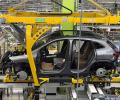
Automobile manufacturers are increasingly vocal about the mounting paperwork and delays associated with India's Production-Linked Incentive (PLI) scheme for the automotive sector, arguing that compliance requirements are becoming as challenging as meeting technical eligibility conditions. They are pushing for a simpler, faster, and more predictable certification and compliance framework.

Foreign Portfolio Investors (FPIs) have withdrawn over Rs 62,853 crore from Indian equities in the first fortnight of June, bringing the total outflows for 2026 to Rs 2.87 lakh crore, surpassing the entire 2025 figure, driven by geopolitical tensions, global economic growth concerns, and a weakening rupee.

The Nifty 50 firms' contribution to the overall earnings of India Inc has steadily declined, reaching its lowest share in at least 21 quarters at 47.1 per cent in Q4FY26, down from 51.8 per cent a year earlier.

Info Edge (India), the company behind Naukri.com, has seen its startup investment portfolio, spanning AI, deeptech, and consumer tech, grow to Rs 41,300 crore from an investment of Rs 4,900 crore since 2007. This significant valuation increase comes despite headwinds in its core recruitment business, which has been impacted by weak hiring trends and IT sector uncertainty.

Robin Liu steps down as India CEO of OnePlus. The company shares key updates on its India operations and future strategy. Here's what it means for the brand and market.

The Defence Research and Development Organisation (DRDO) and the Indian Air Force (IAF) have successfully conducted flight tests of the RudraM-II air-to-surface missile, marking a significant milestone in indigenous defence technology.

The NCERT's Class 9 Social Science textbook now includes the Special Intensive Revision (SIR) of electoral rolls, explaining its purpose to ensure accurate voter lists. The textbook also commends the Election Commission of India (ECI) for conducting impartial polls despite challenges, highlighting the scale and autonomy of India's electoral process.

Andhra Pradesh is set to inaugurate India's first indigenously developed, open-access quantum computer test beds, Amaravati 1S and 1Q, at SRM University, marking a significant advancement in the nation's quantum computing capabilities.

While no Indian institute features in the Top 100 of the QS World University Rankings 2027, IIT-Delhi improved its global standing by climbing from 123rd to 118th place to remain India's highest-ranked institution.

The country's billionaire count rose 58 per cent over the past five years to 207 in 2026.

As a ruler he was a pragmatist and adaptable, and trying all the time to strengthen and perpetuate the empire that he and his forefathers had built.He seldom, if ever, allowed his policies to be determined by his religious beliefs, notes Rudrangshu Mukherjee.

Dr Subhash Kashyap not only enhanced Parliament's image in India and abroad, but also the position of Lok Sabha secretary-general which succeeding secretary-generals have upheld thorough neutrality, objectivity and high degree of professionalism, notes Rup Narayan Das.

Bajaj Finserv announced a strategic initiative to invest up to Rs 2,000 crore in artificial intelligence and technology-led startups over the next five years, along with a collaboration with IIT-Bombay for joint research.

The Indian stock market's movement this week will be significantly influenced by the outcome of US-Iran talks, global crude oil prices, and the trading activities of foreign institutional investors (FIIs), according to market analysts.

Delhi Lieutenant Governor Taranjit Singh Sandhu highlighted the transformative potential of artificial intelligence in enhancing urban governance. He stressed that AI can address complex administrative challenges, improve efficiency in areas like traffic management and environmental monitoring, and shift governance towards an intelligence-driven model, provided it is human-centric and reflects India's diverse context.

Landfill sites are filling up faster than ever, raising concerns about where all our waste will go in the future. India alone produces more than 150,000 to 170,000 tonnes of household waste every day, with each person generating roughly 0.3 to 0.6 kilograms of rubbish daily, depending on the area and lifestyle, as per PIB.

Smallcap funds give investors access to businesses that can grow much faster than the broader economy.

CJP, launched last month, has rapidly gained social media traction among students and young people focusing on youth and education issues

If your All India Rank (AIR) is in the three digits, you could get a seat at one of the prestigious AIIMS colleges and pay tuition fees of just under Rs 10,000 for the entire course. At the other end of the spectrum, if your AIR is in the lakhs, you could end up shelling out a crore at a private or deemed institution.

Larger NGOs could no longer work with smaller ones, especially those organisations working on the ground that had no means of or expertise in raising money themselves, reveals Aakar Patel.

AI firm Pramaana Labs, with a significant Indian workforce, has successfully raised $27 million in seed funding led by Khosla Ventures. The company aims to use these funds to advance its unique technology that converts complex knowledge into machine-verifiable truth, addressing the accountability gap in AI across regulated sectors like tax, healthcare, and financial compliance.
